Showing posts with label Movie Review. Show all posts

Sep 29, 2014

Feature-length movies at the Logan Film Festival

Within the state of Utah, there is a community of filmmakers. A lot of independent movies are created there, and it is home to one of the world's biggest film festivals: Sundance. In Northern Utah, there has been a push for its filmmaking community to be more apparent. Because of the scenic location, it is a good place for people to film, but this fact is largely unknown.

The Logan Film Festival -- which just wrapped up its third year -- has set a goal to make people in that area more excited about filmmaking. In order to do this, it seeks high-quality films from Utah and around the world.

I had the opportunity to be a judge for the student shorts category of the festival. The festival e-mailed films that ranged from 10-30 minutes, and I rated them on a scale of 1-10. In exchange for this, I was able to go to the festival for free and see what other great films there are. There were a lot of showings, and I was only able to see some of the feature-length films.

Ephraim's Rescue: 3.5 out of 5 stars

The event kicked off with a showing of Ephraim's Rescue, a film that has been available on DVD for over a year. The reason this film was shown -- according to an article in "The Utah Statesman" -- was it would appeal to a conservative audience present in Logan, Utah.

This film is based on the true story of a Mormon named Ephraim (Darin Southam), a humble, passionate man who converted to the church around the time many people of that religion were migrating to Salt Lake City, Utah. He seeks every opportunity to serve other people in any way he can. While doing good things, he performs miracles similar to what Jesus Christ did in the New Testament. Because he had received messages from God, he prepares himself for his greatest act of service yet: rescuing a group of pioneers who left too late in the season. Many of these people have been killed because of the harsh weather conditions that they have to continue enduring.

"Ephraim's Rescue" is in no way a perfect film, but considering its budget, it is well-done. It was written and directed by prolific Mormon filmmaker, T.C. Christensen, who has some good moments of dialogue. Ephraim is a relatable character in that he is not perfect even though he has done a lot of good. As someone who is a Mormon, I enjoy the message that being religious is more about helping everyone than being perfect. 

There are some criticisms I have about this film, and about a lot of Mormon films. It was definitely geared towards members of the church and not so much to other people. For someone who knows nothing about the religion, it can be heavy-handed and confusing at times. While some of the dialogue is well-written, it is also a little wooden at times, and the film depends too much on a voice-over narration. Furthermore, the pacing is a little slow at times.

A trap a lot of Mormon filmmakers get into when writing is when people talk about why they joined the church. In this film, Ephraim's brother does this and he sounds crazy. He sounds like a robot who was programmed to say certain things rather than say it from the heart. If any Mormon filmmakers read this, please take my advice and work on the dialogue of these scenes.

20,000 Days on Earth: 4.3 out of 5 stars

This film headlined the Logan Film Festival this year. It won best directing and best editing at the Sundance Film Festival, which was well-deserved. There are a lot of very interesting shots throughout this film that are meaningful to what is going on. 

Nick Cave is a singer/songwriter who does not write for a very broad audience. He writes for himself and for anyone who would be interested. This film is a semi-documentary set in the 20-thousandth day of his life. It features heavy, thought-provoking dialogue, which makes it worth watching, but it bogs the experience down a little. Like Cave's music, this film was not made to be entertaining but to expose people to deep thoughts. See my full review in "The Utah Statesman."

Jammed: 4 out of 5 stars

Evan (David Bly) and Rachel (Leah Rudick) are going to a music festival where a major band will play. It attracts the hippie culture, and they are doing a documentary about it. Everything goes wrong when the camera equipment is stolen and Rachel's wild ex-boyfriend, Mike (Chris Roberti), shows up.

This film is both hilarious and brilliant. There are a lot of gags involving the craziness of hippies while maintaining respect for the peace-loving aspect of the culture. The intelligence of the writing shows with a shift in the characters. At the beginning, Evan is somewhat of a pessimist and Rachel is more optimistic. However, in the end, these roles are reversed.

The nature of their relationship is a little unclear in the beginning, and that makes the third act confusing. There should have been a more buildup to explain this. Another aspect that should have been better is Rachel changes a little too suddenly without much reason. It seems random when it happens.

The One Who Loves You: 4 out of 5 stars

Kathryn Grant both directs and stars in this low-budget film about Gloria Bethune, a struggling singer who gets involved with a scam artist named Roy Hutchins (Briel DiCristofaro). She has no idea that the man she is dating has been lying to her the whole time, but her family and friends have a good idea. Despite all the warnings, she is still in love with him. 

Even though at surface he is a lying scoundrel, his intentions are not all bad. A lot of the film is about how Bethune hires him as her manager after being led to believe that he managed a very successful singer. Amidst al the lies, he genuinely wants to see her succeed whether it makes him rich or not, and this movie deserves praise for making its characters that complex.

I was able to talk with Grant after watching this film, and she said people have told her they cannot believe how stupid her character is. She does not see Bethune that way. She sees the character as a woman of normal intelligence who was tricked. In fact, she has been in a similar situation and was able to draw her performance from that.

The main criticism about this film is the cinematography is too bright at first. This is something you get used to it after some time. The reason for this probably has to do with the film's lack of budget, so it should not be a reason to avoid this movie.

Amber: 3 out of 5 stars

While on the run in Europe, a drug dealer finds a baby at the scene of a deadly car accident. There were two women traveling with the child who had died, and the man takes the baby so he can go places by posing as a father.

The film is well-made and interesting, but it is unbearably dark. While the main character has some charm, he only uses it to get what he wants. He is a psychopath whose only motivation is to keep himself alive and out of jail.

People who read this blog know that I enjoy darker movies/television shows. One of my favorite series is "Breaking Bad," which has some very dark moments. The difference between that and this movie is the main character in "Amber" has no redeeming qualities at first, whereas Walter White is relatable. The protagonist in this film eventually changes, but it takes a long time for this to happen, and when it does, it is unclear why.

Like my Facebook page: www.facebook.com/criticalchristopher

Follow me on Twitter: @ChrisCampbell02


Jul 30, 2014

Quentin Tarantino Month: "Jackie Brown"

Jackie Brown

4.5 out of 5 stars

Family appropriateness rating: 2.25 out of 5 stars
Rated R
-Strong language, including f-words, throughout.
-Gun violence. The wounds are never seen on-screen, but blood splatters on a window in one scene.
-One sex scene. It is a brief depiction of anal sex between a heterosexual couple. It is shown from above the waste, and their clothes are on. However, afterwards, the girl walks away, and the top part of her buttocks are clearly shown.


"Jackie Brown" is difficult to understand at first, but it features the best female character Quentin Tarantino has written.

Jackie Brown (Pam Grier) is a middle-aged, single woman working a dead-end job as a flight attendant. An illegal gun salesman named Ordell Robbie (Samuel L. Jackson) uses her to smuggle money from Mexico to California. Coming off a flight, she is stopped by two cops, Ray Nicolette (Michael Keaton) and Mark Dargus (Michael Bowen). They suspect she is somehow connected to Robbie, and upon searching her bag, they find the $50,000 she is smuggling as well as a small bag of cocaine she did not know about.

She gets put in jail, and Robbie pays her bail. He knows she will be offered a plea deal, which will lead to his eventual arrest. His intention in getting her out of jail is so he can kill her before she says anything incriminating. When he goes to her house, she is prepared with a gun, so he cannot go through with the murder.

Robbie is worried about being caught, and there is still $500,000 more that Brown is supposed to smuggle out of Mexico. He wants that money, but he realizes this will be hard to get because Brown is being watched by the police. Because of this, Brown comes up with a slightly convoluted plan to thwart the police and get Robbie his money. Little does he know, Brown is using him for her own purposes.

The plan Jackie Brown lays out is complicated. What she does is different than what she says she will do. In order to fully comprehend it, I needed to watch it a second time. I am glad I did because I have a greater admiration for Jackie Brown and a better appreciation of the movie.

Brown is the best female character Tarantino has ever written. To say she is a smart, independent woman is an understatement. Certain context clues suggest she has been taken advantage of a lot. Now, she knows when people are trying to use her, and she knows how to stand up for herself. She is at a low point in her life, making very little money, and the plan she has will give her a new, fresh start.

Though the story is complicated, especially at first viewing, it is still enjoyable to watch because each supporting character is entertaining. Ordell Robbie is a despicable man. He only looks out for his own interests, and he is willing to kill people to get what he wants.

Robert De Niro plays another despicable character named Louis Gara. He just got out of jail after having served four years for bank robbery, and he now works for Robbie. Even though they are both awful people, Robbie and Gara are completely different. Robbie is a loud, charismatic salesman. Gara is shy and goes along with whatever he is told to do.

De Niro does a great job at bringing his character to life. He has certain mannerisms that show how introverted Gara is. It is one of those performances that is so good, the actor is almost unrecognizable.

Jackie Brown has a love interest in Max Cherry (Robert Forster), a bail bondsman who is getting tired of his lifestyle. Robbie already has the money for bail, but because he does not want to attract any suspicion, he hires Cherry to get Brown out of jail. Cherry immediately finds her attractive, and he does what he can to help her. Both characters are at a point in their lives where they realize they are getting old, and they both have their share of regrets.

The love story is not the main focus, but it does drive the plot forward. Cherry plays a big role in Brown's plan. The fact that he likes her as more than friends is his motivation for helping her. There is some buildup with the love story that pays off in the end without being sappy.

Like my page on Facebook: www.facebook.com/criticalchristopher

Follow me on Twitter: @ChrisCampbell02

Quentin Tarantino Month:

Introduction
Kill Bill: Vol. 1
Kill Bill: Vol. 2
Pulp Fiction
Django Unchained
Inglorious Basterds
Reservoir Dogs

Jul 28, 2014

Quentin Tarantino Month: "Inglourious Basterds"

Inglourious Basterds

4.5 out of 5 stars

Family appropriateness rating: 2.5 out of 5 stars
Rated R
-Bloody violence: depictions of scalping, blood from gun shots and a depiction of a knife carving into a character's forehead.
-One instance of sexual content: a brief, graphic depiction of anal sex with a heterosexual couple.
-Moderate amount of strong language including the f-word.


"Inglourious Basterds" is Quentin Tarantino's vision of how World War II should have ended. Frankly, it is much better than the history books.

Like "Pulp Fiction," it has multiple stories. However, there are only two, and they are told in a standard, linear chronology that comes together in the end. One of the stories is about Shosanna Dreyfus (Mélanie Laurent), a young, Jewish woman who owns and runs a movie theatre with her boyfriend, Marcel (Jacky Ido).

The movie is set in Nazi-occupied France four years after Shosanna witnesses her family get murdered by the ruthless "Jew Hunter," Colonial Hans Landa (Christoph Waltz). When this happens, she narrowly escapes and assumes the new identity of Emmanuelle Mimieux. Needless to say, she does not like the Germans. She finds an opportunity for revenge against some when the Nazi war-hero-turned-actor, Fredrick Zoller (Daniel Brühl), pulls some strings to have the premier of his movie in her theatre. It is about his patriotic exploits and will therefore be attended by some high-ranking Germans. Shosanna and Marcel plan on using this as an opportunity to burn a large group of Nazis to death.

Unbeknownst to her, the Allies have a similar plan. They want to use the movie premier as a way to end the war with the aid of popular German actress, Bridget von Hammersmark (Diane Kruger) and "The Basterds," Lieutenant Aldo Raine's (Brad Pitt) group of Jewish-American soldiers.

The Basterds are known to the German soldiers as ruthless individuals. They go around killing Nazis and scalping them for proof. The Nazis who survive an encounter with them get a swastika etched into their foreheads with a large knife.

Despite the name of the movie, the Basterds are not the main focus. In fact, there is not one person who can be labelled as the central protagonist. Some may argue that Shosanna is, and that would be fair to say. She is the one person who is given a definite motivation for killing the Nazis. They killed her family, and the audience sees it happen in the intense opening scene. No other person has a backstory that is revealed to the audience.

Quentin Tarantino created a very funny character out of the Basterds' leader, Aldo Raine. Brad Pitt portrays him as a redneck with a southern drawl. He seems ignorant of anything that does not have to do with killing Germans, and he cannot even pronounce the word "Nazis" correctly. The one thing that disappoints me is that he and the Basterds are not in much of the movie. They are only shown together in a few scenes, which are for the purpose of driving the plot forward. It would have been nice for an extra scene to show more about who the Basterds are as people.

This would have been impossible to do because the running time is already two and a half hours, which is surprising because it does not seem that long. Quentin Tarantino knows how to keep an audience involved from beginning to end using smoothly-written dialogue in which the characters have interesting things to say and gives them personality.

The best example of this is found in the opening scene. It involves Col. Landa auditing a French home suspected of housing Jews. He gives a detailed speech about how he is so good at catching Jews because he knows how to think like them. He says this while comparing the hunt for the minority group to a hawk hunting a rat. Not only is this speech worded in such an interesting way, it gives insight into his character. It establishes him as both very confident in his abilities and as a devout anti-semite. This drives the intensity up because it shows that he can more-than-likely guess where the Jewish family is hidden.

In several interviews, Tarantino said Landa is the best character he has written and probably will ever write. He is certainly among the most interesting. He is a strong antagonist who will stop at nothing to get his way. His motivations are complex. At first, he appears idealistically driven because he agrees with the Nazis. However, near the end, it is revealed that his intentions are more self-serving.

Christoph Waltz does such a good job in this movie that he won an Oscar for it. Tarantino wanted so much to work with him again that he wrote a character with Waltz in mind for the movie "Django Unchained." Waltz's characters in both of these movies are polar opposites. In "Django," he is an idealist who believes slavery is wrong. In "Basterds," he is a man who takes pride in killing Jews and thinks black people are less competent. However, the way he talks is very similar. In both films, he has a juvenile charm. He knows how serious certain situations are, but he always attempts to make light of them so he can get what he needs.

A big chunk of the dialogue is subtitled because the characters speak different languages. This does not detract from the entertainment value at all. In fact, it adds a sense of authenticity to the movie. The dialogue is still well-written, but the average American audience member will have to read most of it rather than hear it.

All of the multilingual actors need to be commended for pulling off outstanding performances while speaking other languages. This is especially true of Diane Kruger as the actress Bridget von Hammersmark. She has a two different personalities she gracefully portrays in this film. One of them is the face she makes for the Germans who admire her. The other is who she really is: a spy for the Allies. With the Basterds, she is her real self, but with the Nazis, she is constantly smiling and laughing so she does not get discovered.

Like my Facebook page: www.facebook.com/criticalchristopher

Follow me on Twitter: @ChrisCampbell02

Quentin Tarantino Month:

Introduction
Kill Bill: Vol. 1
Kill Bill: Vol. 2
Pulp Fiction
Django Unchained
Jackie Brown
Reservoir Dogs

Jul 26, 2014

"Hercules" Review

Hercules

2.5 out of 5 stars

Family appropriateness rating: 3 out of 5 stars
Rated PG-13
-Brutal action violence. 
-There is blood, but it is mostly shown after the fact. It is never seen leaving the body.
-Some frightening images.
-Brief backside female nudity for less than a second. There is also a part in which a breast is almost shown, but the woman covers herself before it is.


If Dwayne Johnson did not play the title character in "Hercules," it would have probably been a made-for-tv movie. 

Hercules is a demigod who goes on various missions with his group of friends to make money. They get hired by Cotys (John Hurt), the king of a Greek area called Thrace, to help him overthrow his enemy, Rhesus (Tobias Santelmann), who has been causing a lot of destruction in the land. The movie is about how Hercules trains an army and leads them to find and capture Rhesus. 

There is not much more to say about the film. It is a very simple movie, and frankly it is bland. When there is not any action, it goes into some boring dialogue with boring characters about where they came from. Some of the backstories are interesting, but you also have to sit through some dry banter before hearing them. 

With Hercules, the sky is the limit. The filmmakers could have given us an epic tale from his life. What we get is some generic plot that seems like a bad Syfy Channel Original Movie. The characters are bland, and there is very little that distinguishes them from one another. The only ones that I find remotely interesting are Iolaus (Reece Ritchie), the storyteller, and Amphiaraus (Ian McShane), the man who can see pieces of the future. 

Dwayne Johnson's performance is what anyone would expect from him. He is not exactly an Academy-Award-worthy actor. He is a muscle head who was once a professional wrestler. His acting ability reflects his previous career, and there were times I thought I was watching World Wrestling Entertainment. 

To make his role worthwhile, he should have talked less and fought more. Some of the action scenes brutal, hard hitting and cool. When there is a throw down, it is very entertaining. However, the action scenes are so few and far between, that it is ultimately not worth seeing.

This movie gets half a star more than I thought it would because of the third act. There is a twist at the end of the second act that was unexpected and interesting. The last part deals with Hercules's backstory, and the resolution is well-executed.  

Like my Facebook page: www.facebook.com/criticalchristopher

Follow me on Twitter: @ChrisCampbell02

Jul 25, 2014

"Lucy" Review


Lucy

2.8 out of 5 stars

Family appropriateness rating: 3 out of 5 stars
Rated R
-Moderate amount of sexual content. There is a brief shot of sexual activity in the back of a car. No nudity is shown, but the motions make it obvious what they are doing.
-Depictions of blood as a result of violence and surgery. No gruesome camera shots of blood coming out of the body.
-There are some disturbing images.
-Little to no profanity. The f-word is almost said, but it is cut off.
-Pretty light R rating.


The "science" is flawed and the characters are poorly written, but "Lucy" gets its entertainment value from moments of interesting dialogue and off-beat direction.

Scarlett Johansson plays the title character, Lucy. After a chain of events, she is captured by a Chinese mob, which is testing a new drug. It is a highly concentrated dose of a woman's hormone that   speeds up the growth process in the womb. For fully-grown adults, the drug speeds up neural activity in the brain. The mob surgically inserts a bag of it into her body, and she develops a higher level of brain power as it enters her blood stream.

The film is based on the premise that we as humans only use 10 percent of our brain. When Lucy first takes the drug, she starts using 20 percent. As the movie progresses, the percentage gets higher. The problem with this concept is it is completely false. In reality, we use every part of our brain, and it is constantly working. Different parts are used for different things: some are used for memory, some for judgement and some for breathing. The whole thing may not be activated all the time, but every part is used.

Even with a suspension of disbelief -- which is required by most of this film -- there is no definite limitation to the percentages. When she is at 20 percent brain capacity, she already seems invincible. She can understand Chinese, manipulate waves and even read minds. The only difference in her progression is near the end, her powers get so advanced that nothing can hurt her.

Scarlett Johansson does a good job with what she has in this movie. In the beginning, Lucy goes through an intense situation, and Johansson does a great job conveying the emotion required to make it realistic. Even though we do not know anything about the character, she is at least relatable because she is well acted.

This is in direct contrast to what happens to her personality when the drug is administered. She becomes monotoned and flat. This happens because as she gains more knowledge, she becomes detached from all emotion. She cares little about human lives as she seeks her goal to get more of the drug. The character is dependent on it to survive, and she must get it from other people who also had it inserted into their bodies by the mob. For some reason, none of these people actually had the drug enter the blood stream. It just stayed in the bag.

Even though the movie is flawed, it is surprisingly engaging. Part of this has to do with the dialogue. It is written well enough so when the false-scientific claims are explained, it is still interesting to listen to. The speeches are done by Morgan Freeman who plays Professor Norman, a scientist who has spent his life developing his theory about what would happen if humans unlocked more of the brain. His voice combined with visuals of nature also help carry the entertainment value of the explanations.

The direction of this film is odd but fun to watch at the same time. When Lucy gets into the situation with the mob, writer/director Luc Besson intercuts a cheetah hunting its prey to foreshadow what will happen. Though this choice seems forced, it succeeds at making the scene more interesting.

Certain concepts that this film tries discuss are confusing. Besson seemed to have been going for a science-fiction experience comparable to "The Matrix," which is both a thought-provoking and action-packed film. He does not succeed at the same level. Yes, some of the concepts make you think, but they are not as clear and relatable as the 1999 classic nor are the characters as well-written.

With that being said, there is a scene in the end that utilizes some very impressive visuals to explain the confusing concepts. It depicts space, time and the creation of earth. The visual effects team deserves to be commended for it.

Like my Facebook page: www.facebook.com/criticalchristopher

Follow me on Twitter: @ChrisCampbell02

Jul 20, 2014

Quentin Tarantino Month: "Pulp Fiction"

Pulp Fiction

5 out of 5 stars

Family appropriateness rating: 2 out of 5 stars
Rated R
-Some mildly descriptive sexual content (mentions of oral sex).
-One disturbing depiction of male-on-male rape. It is shot from the back, and the men are wearing their clothes. However, it is still graphic in that the action itself is shown.
-One scene of sensuality, and a scene in which a man taking a shower barely covers his private parts.
-Strong language throughout including f-words and n-words.
-I rate it up a little bit in this area because it has an uplifting, religious message to it.


Watching "Pulp Fiction" is like listening to a catchy song. It is a pleasurable experience that sticks with you the first time and does not disappoint in subsequent viewings.

It is not a typical film with one central plot. It has three stories told out of order that relate to each other. Each is about someone involved in a gang led by Marsellus Wallace (Ving Rhames).

One story is about two hit men, Jules (Samuel L. Jackson) and Vincent (John Travolta), who have to retrieve a briefcase from an apartment. Another story is about Vincent taking Marsellus's wife, Mia (Uma Thurman), out to dinner at the gang leader's request. The third story is about a boxer named Butch (Bruce Willis) who is told by Marsellus to throw the next fight but decides not to do so.

To someone casually watching, the stories seem completely random. In fact, when I saw it, I was not sure what they have to do with each other. After some thinking, I figured out that the movie has one central theme of redemption, which can only be understood after watching the movie in its entirety. In each story, something goes wrong, and the characters have to deal with it. Each person has a different motivation for wanting to do the right thing. Only one has selfish motivations behind his actions, and his fate is different than the other two. More about this is explained in the spoiler section of this review.

I have heard people say they get bored watching this movie. I assume this is because most of the film is dialogue. There is some action, but it is mostly people talking. It is not the type of movie to watch with chatty friends who make it hard to focus. In order to get the full experience, one needs to listen to every word the characters say.

Like in his other films, Tarantino uses dialogue to establish characters and detail situations. Although a lot is exposition, it never feels forced because it is in the form of banter between two people. An example of this is in the beginning. Vincent and Jules are introduced as regular guys going to work. They do not talk about what they are going to do so much as they are talk gossip about what happened to a certain gang member for overstepping some boundaries with Marsellus's wife.

Not only does this detail why Vincent is nervous about taking Mia out to dinner, it establishes the culture of the gang as something relatable. It is not just gangsters who gossip, it is any group of people. It reminds me of when I served a Mormon mission. I had a lot of conversations about issues going on with other missionaries.

My favorite story is the one in which Vincent takes Mia out. I consider myself a movie fan, but there are often a lot of aspects about I overlook. One such thing is set designs, but there is one set in this movie that I am impressed with. It is the restaurant where the two characters eat. It is a beautifully-crafted set, and Tarantino takes time to show everything in it using one long take of the camera following Vincent.

It does not hurt that Uma Thurman's Mia character is in that scene as well. A combination of the way her character acts and the way she looks makes her attractive. She is an outgoing woman with a fascination for understanding the world around her. There is an extra layer on her that is never really explained. She never says she is dissatisfied with her marriage or her husband's decisions, but her excessive drug use paired with her flirtatious attitude with Vincent suggest that she might be a little sad about the way her life has been going. Part of what makes her character great is the fact that it is never explained. It is one of those things the artist puts out there to let audience members interpret themselves.

There is one scene in the Vincent story that is both intense and hilarious. It is set within a drug dealer's house as characters are frantically trying to take care of a situation. Tarantino adds to the intensity by taking one long take in which the camera is constantly moving to every character when he or she speaks.

Every performance is phenomenal. In the Blu-ray special features, John Travolta expresses gratitude to Quentin Tarantino for casting him in such a great role. It was filmed in the early '90s when Travolta's career was not very good. The movies he was being cast were dumb "Look Who's Talking" films, and since "Pulp Fiction," he started to get taken more seriously.  Judging from his performance as Vincent, he deserves to be successful. He does a great job as a hit man who is just trying to do his job without any trouble.

Samuel L. Jackson is another actor who needs to be recognized for this movie. He brings a lot of personality to his character, especially when he confronts the men in the apartment. Jules is intimidating to them, but to the audience, it is obvious he is playing. Jules undergoes a rapid change that transpires after a certain event. Jackson does a great job showing this change in a way that does not seem forced.

It helps to watch "Pulp Fiction" multiple times. The stories are out of chronological order, and part of what makes it fun is realizing how consistent every little detail is. For example, there is a part in which Jules and Vincent go into a bar wearing gym shorts and t-shirts as opposed to their classy tuxedos in previous scenes. There is a reason for this, but it is never shown until later in the film.

The message of redemption (spoilers)

When I first saw this movie, I liked it. It is an example of how entertaining a film can be without blowing a huge budget on expensive action scenes. However, I knew there is a lot that I did not completely understand. The main question I had was "Why are these particular stories in the movie?" As stated earlier, this question is something I thought about the next day, and I came up with a tentative answer that it is about redemption. This section goes more in depth with this. It may not be what Tarantino meant, but it is my interpretation of it as an audience member.

When Vincent and Jules are in the apartment, they shoot everyone in the room except for one man named Marvin (Phil Lamarr). Meanwhile, there is another person in a different room listening to the whole incident. Enraged, he jumps out and fires six shots in close range at the hit men. All six miss and hit the wall behind them.

Jules is amazed. Not one bullet hits them. He sees this as an act of God, a miracle. Vincent, however, does not believe it. He thinks it is a strange coincidence but not divine intervention. Jules tells him he cannot be so picky about miracles. What God chooses to show is not always some big flashy sign.

In the end, Jules decides to give up his life of crime. He shows he is a changed man when he helps two bandits realize they should change their lives too.

Vincent should have changed because of the miracle at the apartment, but he stays the same. He is a heroin junkie, who only cares about himself. He finds Mia attractive, and he is afraid of succumbing to his sexual desires. This is not because he feels adultery is morally wrong but because he is afraid of what Marsellus would do if he found out. She ends up overdosing on Vincent's heroine, thinking it is cocaine. This worries him, but it is more out of worry for his own life than out of general concern for her. His reward for being self-absorbed and not changing his ways is he gets shot by Butch.

Butch's story is seemingly the most disconnected from the rest of the film, but even it is about being the better person. Not only does Butch win the fight, he accidentally kills his opponent. Marsellus is angry, and Butch knows it. In fact, he has an escape plan. He and his girlfriend are hiding in a motel, and they are to run away in the morning. Things get complicated when the fighter realizes his gold watch -- which has been in his family for generations -- is still in his apartment. Knowing there are more than likely gang members there, he goes back to retrieve the valuable item.

This leads him to find Marsellus on the street. They get into a fight, and Butch almost kills the gang leader before being stopped by a perverted pawn shop owner named Maynard (Duane Whitaker) who captures them. They end up in his basement where they are to be taken advantage of sexually by the captor and a cop named Zed (Peter Greene).

Marsellus goes first, and Butch manages to escape. He is just about to leave the shop when he realizes that there are some horrific things happening to a human being downstairs. Even though he has had some disagreements with that particular person, he goes back and saves the man. Because of this, the gang leader promises Butch that he will not send anyone to look for the fighter under the condition that he leave the city that day and never return. Had Butch not helped Marsellus, the gang leader's men would have eventually tracked and killed him. In the end, the fighter's good deed is rewarded.

Like my Facebook page: www.facebook.com/criticalchristopher

Follow me on Twitter: @ChrisCampbell02

Quentin Tarantino Month:

Introduction
Kill Bill: Vol. 1
Kill Bill: Vol. 2
Django Unchained
Inglourious Basterds
Jackie Brown
Reservoir Dogs

Jul 14, 2014

Quentin Tarantino Month: "Kill Bill: Vol. 2"

Kill Bill: Vol. 2

5 out of 5 stars

Family appropriateness rating: 2 out of 5 stars
Rated R
-Several scenes of action violence including somewhat gory depictions of someone's eyes coming out.
-Strong language throughout including f-words and one use of the c-word.
-Some sexual content


"Kill Bill: Vol. 2" is more than a continuation of the first film. While it does end the story, it takes a step back from the action and gives insight about the characters.

The new information also new meaning to the rest of the story. In "Vol. 1," Quentin Tarantino does not let the audience know a lot of information about who the protagonist is. We know the basic motivations behind the Bride wanting to kill Bill, but we do not know why Bill wanted to murder her in the first place.

Near the beginning of this film, it is revealed what the relationship between Bill and the Bride had been previous to the attempted murder at the wedding. Tarantino does this by showing a moment between them at the church before the other members of the Deadly Viper Assassination Squad comes to attack.

That scene only reveals part of why Bill does something so horrible. Without spoiling anything, there is something the Bride has done as well, but her motivation is not revealed until she confronts Bill in the end.

This movie is yet another demonstration of Tarantino's superb use of dialogue. He does not lazily force exposition from his characters' mouths. The dialogue flows naturally and allows the audience to make connections on its own.

The character who gets the most interesting speeches is Bill. While there is still very little known about his backstory, he is depicted as an intelligent, insightful man. During the final confrontation, Bill makes an observation about the uniqueness of Superman. He says the superhero is the only one whose secret identity is the innocent civilian. His true self is an alien on earth with incredible powers. This speech ties into an explanation of the Bride's situation in a way that gives depth to the character without confusing the audience.

Before taking vengeance on Bill, the Bride still has two more people she wants to kill. This leads her into a precarious situation that would be near impossible to get out of for any normal human being. However, the Bride has some abilities most people do not have, and the reason for this is revealed in a flashback that directly connects to what is happening. It shows how she was trained, from whom and how she learned the specific move she needs to get out of her position.

There is another character named Elle Driver (Daryl Hannah) who has roughly the same backstory. Her and the Bride were trained by the same person, Pai Mei (Chia-Hui Liu). However, Elle is not a very good person. Her badness -- contrasted with the Bride's goodness -- is highlighted when comparing their individual experiences with Pai Mei. They both undergo criticism from him, but they handle it differently.

This installment is not as gory and as "Vol. 1." There are a few action scenes, but none of them show blood squirting out of bodies. The first film is more about the action, and this is more about the characters. I did not like it as much at first. Compared to the first one, it seems slower, but that is because the emphasis is on different things. Anyone who sees it needs to understand that "Vol. 2" and "Vol. 1" are completely different films.

My thoughts on the ending (spoilers):

When Bill is about to shoot Beatrix Kiddo (since this section reveals spoilers, her real name will be used in it), he tells her this is him at his most masochistic. It is impossible to know what he means by this at first, but it ends up being an important line because it highlights the complexity of Bill's emotions.

By the end of this film, we know that prior to the story, Beatrix and Bill are in a romantic relationship. In fact, Beatrix is carrying his child when he shoots her, and the infant survives without her knowing. Their relationship first turns sour when Beatrix realizes she is pregnant. She does not want the child to grow up with the lifestyle she is living with Bill, and she runs away, still in love with him.

Bill becomes angry and tracks her down to find that she is getting married to someone else. Not only that, she is pregnant. Bill does not realize it is his child when he shoots her.

Bill tells her he is being a masochist when she calls him a sadist. These are two words that describe someone who finds pleasure with pain. While a sadist likes to inflict pain on other people, a masochist likes to be in pain. When he shoots her, he still loves her. It causes him deep, emotional pain as he does so. At the same time, he is taking revenge on how she wronged him, and that is pleasurable to him.

Bill's emotions are twisted, complicated and bittersweet, and that is the feeling I get from the resolution of the film. Beatrix clearly has feelings for him, but she also feels she needs revenge for everything he had put her through. In the end, the film goes from being a straight-up tale of vengeance to a complicated, tragic love story.

Like my Facebook page: www.facebook.com/criticalchristopher
Follow me on Twitter: @ChrisCampbell02

Quentin Tarantino Month:

Introduction
Kill Bill: Vol. 1
Pulp Fiction
Django Unchained
Inglourious Basterds
Jackie Brown
Reservoir Dogs

Jul 11, 2014

"Dawn of the Planet of the Apes" Review

Dawn of the Planet of the Apes

5 out of 5 stars

Family appropriateness rating: 4 out of 5 stars
Rated PG-13
-Moderate amount of language including one f-word
-Non-gory action violence throughout including guns. One gun shot wound is shown, but it is not gory.
-The character design of Koba might be frightening to some younger audiences.
-I rated this up in family appropriateness because it has themes that family's might appreciate.


"Dawn of the Planet of the Apes" does for the "Apes" franchise what "The Dark Knight" did for Batman. Not only does it push the characters from the previous film forward, it presents a story that stands on its own and gives insight into human nature.

It has been years since the events of the first film. Many humans have died off from a deadly virus brought about by an experimental drug that was tested on an ape named Caeser (Andy Serkis), who became highly intelligent because of it. He gave the drug to a bunch of other apes, and they all gained the same intelligence. Having rebelled against the humans, they now live in a forest colony outside San Fransicso.

Caeser is the leader of them. He is now more mature, having spent years as the one responsible for who he considers his family. He is also much wiser than the rest because he has had a deep, personal connection with humans. His experiences have led him to the knowledge that there is both good and bad in humanity.

Not every ape understands this. There is one named Koba (Toby Kebbell) who had been tortured by humans before the rebellion. He has only seen the ugly side of humanity, and he thinks they are all awful.

For years, the humans and apes have been living separate lives. This changes one day when some humans unknowingly stumble onto ape territory. Humans are running out of electricity in their colony located within the city, and they know there is a dam around the area that could provide hydroelectric power. They want to find a way to turn it on. However, it is in the ape colony and some apes -- such as Koba -- do not have a lot of trust in humans.

Caeser agrees to let a few humans stay for three days to figure out how to turn the dam on. His condition is they cannot have guns in the area. Malcolm (Jason Clarke), the leader of these few humans, honors Caeser's request. However, not all of the humans respect the apes like Malcolm. Complications arise because of this and because of Koba's distrust.

This film explains one of the biggest problems in modern-day society. It is about the dangers of stereotyping. Not only does Koba think all humans are bad, one of the humans named Carver (Kirk Acevedo) also blames all apes to be the root cause of his problems. Most of the characters -- both apes and humans -- want to avoid killing each other, but there are those few on both sides who believe the other needs to be eliminated.

This is the same thing that happened around 9/11.  On that day in 2001, there were a few Muslims who hated Americans and resorted to killing a lot of them. A lot of Americans became angry at all Muslims, thinking they were evil people, and the religious group underwent a lot of persecution because of it. My own experience has led me to believe they are generally peaceful people. Not all of them would even dream of doing something as horrific as what was done that day. It is just a few that cause problems. Likewise, only some Americans overgeneralized their hate to encompass all Muslims.

What is amazing about both "Rise of the Planet of the Apes" and "Dawn of the Planet of the Apes" is how much characterization is given to the animals. Both films are more about the apes than they are about the humans, and it is just as engaging as it would have been the other way around. There is also a decent amount of development given to Malcolm. This makes it engaging because during the climax, there is enough emotional investment on both sides to make the audience generally concerned about what happens.

The characterization of the apes could not be accomplished as potently as it is without the use of motion capture technology. The animation is done using real actors, and their facial expressions look very real. There is one scene in the beginning when Caeser meets his newborn son, and it is very powerful because the look of happiness on his face is so clear.

Andy Serkis is the one who does the actions and voice for Caeser. He is notable for doing a lot of motion capture roles, his most famous being Gollum from "The Lord of the Rings" movies. He has been trying to get the Academy of Motion Picture Arts and Sciences to create an Oscar category for motion capture. While I do not agree there is enough movies shot that way to justify an entire category, he deserves to be nominated for best actor in a leading role for this movie.

Like my Facebook page: www.facebook.com/criticalchristopher
Follow me on Twitter: @ChrisCampbell02

Jul 9, 2014

Quentin Tarantino Month: "Kill Bill: Vol. 1"

Kill Bill: Vol. 1

4.5 out of 5 stars

Family appropriateness rating: 0.5 out of 5 stars
Rated R
-Graphic, bloody violence throughout.
-Strong language throughout including f-words and several c-words
-Moderate amount of sexual content including a brief, animated depiction of statutory rape about to happen (it does not actually happen though)


The introduction to Quentin Tarantino month mentioned that I would lump both "Kill Bill" movies together. My reasoning was they are one story. While this is true, I changed my mind. They do make up the same story, but they are completely different films that can easily be discussed individually.

"Kill Bill: Vol. 1" is a stylized revenge film about a woman (Uma Thurman) who seeks revenge on a man named Bill (David Carradine) for nearly killing her.

There is no mention of the woman's name in the first installment. She is either referred to as "The Bride" -- having been found unconscious at a small wedding, wearing a white dress -- or her secret assassin name "Black Mamba." In some scenes, her real name is uttered, but a distinct <bleep> sound covers it.

The Bill character is also an enigma. His voice is heard in several scenes, but all that is shown are his hands. His face is never revealed until the second movie. All we know is he is the leader of the Deadly Viper Assassination Squad, which The Bride was once a part of. Details about his relationship with the protagonist are unknown.

All that is given to the audience is just enough to know why Black Mamba would want to seek revenge on Bill. The film opens to him shooting her in the head. When detectives find her, they think she is dead, but upon realizing she is not, she is taken to a hospital where she spends four years in a vegetative state.

When she wakes up, she is angry: not just for having been shot, but because she was pregnant during the attempted murder. She finds that she is no longer carrying the baby and assumes the unborn child was killed.

Bill is actually the last person on her list to kill. There are several other people from Bill's assassination squad who were present during the assassination attempt, and she intends to save the most important for last. Vernita Green (Vivica A. Fox) is one of these people, and the Bride confronts her at the beginning.

This bulk of this film focuses on Black Mamba going after O-Ren Ishii (Lucy Liu), the brutal leader of a criminal underground in Tokyo. While there is not a lot explained about where the Bride came from, there is a lot of description about O-Ren. A big chunk of her background is explained in a beautifully-drawn anime that does a great job creating a relatable character who the audience can sympathize with. She is later developed as a murdering psychopath, but at least she has reason to be.

Tarantino knows exactly what to do in every shot to create an atmosphere that is wildly entertaining. This is especially true as the Bride goes to the house of O-Ren to confront her. The way the set is colored combined with the background music and the way the camera follows the main character makes it perfect. Not only are these shots visually stimulating, they create sufficient buildup for the action-packed climax.

This film came out just five days before I turned 14, and the only thing I had heard was how violent it is. It has been said that over 450 gallons of fake blood were used to make it. After actually watching it, I do not doubt this fact. There is a lot of blood! However, it is different than I imagined. It is not realistic like in war movies. It is comical. Whenever limbs get chopped off, blood spews out sporadically. It is even weirder when people are stabbed: a volcano of blood explodes out of their stomaches.

This aspect is both visually appealing and disturbing. It is disturbing because of how entertaining it is. This is why I would not recommend it to anyone who does not understand the basics of both biology and human ethics. Only well-adjusted adults should watch it with a critical eye that it is purely for entertainment. Young people or someone who does not know right from wrong may think the blood looks cool and try it out.

That is something Tarantino and I may not see eye-to-eye on, but I believe it to be possible both because of my religious background and my background in psychology. There is a well-known study by a man named Alfred Bandura in which children were shown an adult behave aggressively towards a doll. The kids were then able to play, and those who had observed the aggressive behavior were aggressive towards it as well. This is called "modeling," and it has been tested many other times and shown to be a real phenomenon. We learn by watching other people and that is why we need to be careful when watching a violent film like this. This film gets a strong recommendation from me, but those who watch it should be cautious about the violence.

Like my Facebook page: www.facebook.com/criticalchristopher
Follow me on Twitter: @ChrisCampbell02

Quentin Tarantino Month:

Introduction
Kill Bill Vol. 2
Pulp Fiction
Django Unchained
Inglourious Basterds
Jackie Brown
Reservoir Dogs

Jul 3, 2014

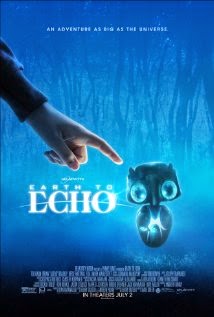
"Earth to Echo" Review

Earth to Echo

 2.5 out of 5 stars

 Family appropriateness rating: 4.5 out of 5 stars
 Rated PG
 -Mild language
 -Mild violence
 -Mild sexual content


"Earth to Echo" is no "E.T. The Extraterrestrial," but it certainly tries to be.

Alex (Teo Halm), Tuck (Brian "Astro" Bradley) and Munch (Reese Hartwig) are three friends who are about to be separated because of a new highway system being built where they live. They want to make the most of what little time they have together, and an opportunity for adventure comes their way when their phones act up. After some investigation, they discover that a map has been transmitted to them. This leads the boys to a small, robot-looking, alien life form, which they name Echo. It needs to repair its ship to get home, and the boys spend an entire night to help it do so.

In the middle of the film, another character named Emma (Ella Wahlestedt), tags along. This movie deserves props for having a strong female character. She gets information that the boys never thought of getting. It is funny that Tuck is the self-appointed leader of the group, but she is much more competent than him. The movie does not delve much into this aspect, but he gets jealous of her.

The movie was filmed in the same style as a found-footage production, much like "Paranormal Activity" and "Cloverfield." However, I do not think it can be appropriately called that because as far as anyone knows, no one really found it. Tuck is the one who is filming everything, and he also narrates it. Because of this, he is the only one -- besides Emma -- who is given very much depth. It is easy to connect with him and his sadness over his friends moving away because I have been in that situation before. He is also the person who instigates everything, and the rest of the group follows along.

The filmmakers clearly tried to make this like "The Goonies" by adding a slightly chunky kid named Munch, who Tuck describes as "weird" in his narration. There are habits he has that are a little odd -- like hoarding behavior -- and it is briefly revealed that his mother is going through a divorce. Other than that, the film does not give a lot away as to how or why he is described that way. There is very little depth to him, and he is pretty much just the wuss of the group.

A problem with this film is it relies on telling who these characters are rather than showing them. This is especially true of Alex. I think he is supposed to be the rebel, free thinker of the group, but that is just because of what other characters say about him. He seems to be the person who Echo likes the most, but there is no reason given as to why this is.

The character design of Echo is slick and visually appealing. It would have been nice to have seen it for more of the film. It does not get a lot of screen time, and therefore it is not given much characterization. This movie would have been so much better had the writers focused on giving it a personality. The kids just find it and do everything they can to help simply because it will not harm them. They do not get to know the alien at all, which makes the conclusion less emotionally satisfying than what it aims for.

This movie would have benefited had it not been a "found-footage" film. It does not seem like any of the actors know what to do in this style of film making. This is partly because the main actors are very young and inexperienced, but even some of the adult actors give laughable performances. There is very little that feels believable. It is like watching people try to act.

My theory is had this film not been "found footage," it would have been too much like "Super 8," a much better film that was released in 2011. That movie has essentially the same idea: a group of minors making a movie find some strange alien activity. The way the alien ship works in both films is even similar. The differences are that the 2011 film is done like an actual movie with professional cameras, the acting is far superior and the characters are developed a lot better with well-defined personalities. If I were you, I would save money on this and watch "Super 8." It may not be as appropriate for families, but it is a lot better.

Like my page on Facebook: www.facebook.com/criticalchristopher
Follow me on Twitter: @ChrisCampbell02

Jul 1, 2014

"Tammy" Review

Tammy

2 out of 5 stars

Family appropriateness rating: 2.5 out of 5 stars
Rated R
-Moderate amount of strong language including f-words in both sexual and non-sexual contexts
-Moderate amount of sexual content
-Some shots of a man and woman making out in a car. It is implied that they are either having sex or they are about to, but it is not very explicit and nothing is shown.


"Tammy" is an uninspired film that attempts to get laughs by being as loud as possible.

Melissa McCarthy plays Tammy, an uneducated, incompetent, obnoxious woman, who is at the low point of her life. In one day, her car dies after hitting a deer, she gets fired from her job, and she finds out that her husband has been cheating on her with a more attractive woman.

With nowhere to go in her life, she decides to run away from her troubles. She goes off on an adventure to find herself with her grandmother, Pearl (Susan Sarandon), who Tammy only agrees to go with because she has a functioning car.

Pearl is the best part of the film. There are some genuinely funny moments that involve her. She is an older woman who is young at heart. She is also an alcoholic who brings various beverages with her. She intends to live life to its fullest, and she does not want to die alone. That is the reason she goes with Tammy. She has been living with Tammy's mother, and she is tired of being in that house.

Susan Sarandon and Melissa McCarthy have good chemistry. The best moments between them are not necessarily funny, but they are sentimental and add depth to the characters. Tammy is annoying, but it is obvious that the writers cared about her.

Melissa McCarthy is notable for her role in "Bridesmaids." She is very funny in that film. This is the only other movie I have seen her in. Judging from these two productions, it seems the reason she was so good in the 2011 film is she has a supporting -- as opposed to a leading -- role. Her character is used sparingly, so her scenes are funny. Had she been the lead, she would probably get annoying.

In "Tammy," she is the lead, and her character is abrasive. She is funny at times, but for the most part, the comedy relies on her being incredibly loud and dumb. For the most part, this comes off as more annoying than comical.

There is an attempt at a character arc. She gets less annoying in the end, but it is difficult to pinpoint exactly why she changes. It is more than likely because her grandmother pays attention to her, and she finds meaning through this relationship. However, the story is not written well enough to make it as obvious as it needed to be.

There is also a romance between Tammy and a man named Bobby (Mark Duplass), but it is developed poorly. At first he does not seem interested in her, but then he is all of a sudden. The poor development is partly due to the fact that he is in a couple of scenes, disappears and then reappears again. He is also given no personality, and in the end there is no reason to care about this aspect of the film.

The most hilarious part is when Tammy robs a fast-food restaurant. That would be a spoiler had it not already been in the teaser trailer. This scene and a couple of others are the only reasons to see this film. However, I will spare you from having to spend money by putting the clip right here. There is a little more to this scene, but the trailer highlights most of what makes it funny.


Like my page on Facebook: www.facebook.com/criticalchristopher
Follow me on Twitter: @ChrisCampbell02
Jun 27, 2014

"Transformers: Age of Extinction" Review

Transformers: Age of Extinction

2.5 out of 5 stars

Family appropriateness rating: 3 out of 5 stars
-Action violence throughout, mostly between robots.
-A man is shown falling to his death
-Mild gore from a large gun wound in a dead man's chest
-Moderate amount of language including one censored f-word and one uncensored.
-One or two instances of sexual innuendo that would go over kids' heads.


With an interesting concept about government conspiracy, "Transformers: Age of Extinction" has so much potential to be really good, but it falls short.

Following the near-destruction of Chicago during "Dark of the Moon," both Autobots and Decepticons are in trouble. They are being hunted down and eliminated by American black ops forces.

Many are in hiding, including Optimus Prime (voiced by Peter Cullen), who is disguised as a junky, old semi. He is found by Cade Yeager (Mark Wahlberg), an inventor in Texas who is struggling financially. After finding out that what he brought home is a Transformer, he does what he can to fix it. The CIA gets word of this, and the black ops team goes to Yeager's house to take Optimus Prime away.

This sets off a chain of events that leads Cade, his daughter Tessa (Nicola Peltz) and her boyfriend Shayne (Jack Reynor) to help Optimus Prime find out what is going on. It turns out there are some corrupt people behind the hunt for Transformers. They have their own motivations, but they do everything in the name of the country's security.

I like this aspect because it is perfectly relevant to certain events that have come about recently. It has been revealed over the last few years that the National Security Agency has had access to personal information of law-abiding citizens. Government officials insist that it is for he safety of everyone, but there is a lot of discussion as to whether or not that is the full truth.

This aspect is carried out by the two antagonists: Joshua Joyce (Stanley Tucci) and the Harold Attinger (Kelsey Grammer). Joyce is an entrepreneur and perfectionist who does not understand the power he is dealing with. Attinger is a cold, threatening man who leads the CIA. Both performances are the best part of the film. They are strong actors who are able to make their characters interesting to watch.

The government conspiracy angle is only discussed a little bit. Once the plot picks up, the focus goes to robots fighting, people running and a ridiculous amount of things blowing up in ridiculously huge explosions. There is nothing wrong with action in films, but sometimes it becomes the entire movie, and that is not how it should be.

Director Michael Bay could have redeemed this by trimming it down quite a bit. The run time is two hours and 45 minutes. Most of it is either action or a superfluous plot point. There are entire sections that could have been cut out, and the movie would have been much better.

As it stands, it is difficult to care about what is going on after about one and a half hours. At about that point, my mind started wandering, wishing the film would wrap up so I can go on with my day. A good movie should not do that. If the director decides to make it very lengthy, there better be a lot of depth and character development. That is not how this movie is.

For the most part, the characters are just there to drive the action along. There was potential for some good development. The beginning sets up the father-daughter relationship well enough to create a very intense moment in which Cade fears for Tessa's life. After that, however, little is done with the protagonists.

Like my page on Facebook: www.facebook.com/criticalchristopher
Follow me on Twitter: @ChrisCampbell02

Jun 13, 2014

"How to Train Your Dragon 2" Review

How to Train Your Dragon 2

4 out of 5 stars

Family appropriateness rating: 4.5 out of 5 stars
Rated PG
-Mild violence. Any potential gore is off-screen and left to the imagination.
-Some images may be frightening to some children.
-I think there might be a brief reference to prostitution, but I may have hear wrong.


Though not as good as the first one, "How to Train Your Dragon 2" carries the characters forward and uses impressive visuals to expand the universe.

It has been five years since the events of the first film, when the vikings of Berk decided that dragons are not evil creatures like they had thought. Now, the vikings use them to ride and play sports.

The hero from the first movie, Hiccup (Jay Baruchel), is as adventurous as ever. Now that it is safe to openly ride his dragon without fear of the townspeople finding out, he uses the ability of flight to explore the world and see what more it has to offer than his little island. While doing this, he stumbles upon some dragon trappers who work for Drago (Djimon Hounsou), an evil man with the power to control dragons.

When Hiccup tells his father, Stoick (Gerard Butler) — the chief of Berk — about the encounter, the viking leader commands the townspeople to prepare for an attack. Hiccup and his father butt heads about what to do. Stoick just wants to defend the city, but Hiccup wants to try negotiating with Drago so there would not be an all-out war. Going against his father's demands, the hero runs away from Berk to talk with the leader of the dragon trappers.

In the first film, Hiccup learns a lot about tolerance towards other creatures. He learns that everything he had been taught about dragons is wrong, and they are actually gentle animals. In this film, his character grows even more. The writers were able to use some good moments of high conflict to illustrate that he needs to become more responsible. At first, his decisions seem irrational, but that is the intention of the writing. They are not very good decisions, and he learns from his mistakes.

The animation is just as breathtaking as the first film. It is still obviously animated, but the details make it look as real as possible. Not only that, it is aesthetically pleasing to watch. One of the best scenes is near the beginning when Hiccup is first shown riding his dragon, Toothless. It is very smooth, and the movie would have been fine had it just shown that for one and a half hours.

It is necessary for the animation to be as good as possible because this movie expands the universe very well. All of the characters in the first film are based in Berk. However, this one deals with characters from different lands. The writers and animators together do a great job making the world bigger.

The main problem with this film is it tries really hard to entertain young children with jokes that are pretty cliché for G and PG movies. There are some genuinely hilarious moments, but there are others — particularly when dealing with Hiccup's obnoxious friends — that seem forced and take me out of the movie.

While the villain is pretty cool, I was slightly disappointed with him. The movie really does all it can to make him as threatening as possible, and it succeeds for the most part. However, I was expecting something as iconic as Lord Voldemort from the amount of buildup he got. Characters constantly play him up to be this horrible, ruthless man. This is true, but I was personally expecting something more.

This film is not as good as the first "How to Train Your Dragon," but it would be incredibly difficult to top it. While the ending of that film leaves it open for a sequel, it was never absolutely necessary. However, for fans of the 2010 film, this movie is worth seeing.