Showing posts with label Samuel L. Jackson. Show all posts

Aug 5, 2014

Quentin Tarantino Month: Conclusion

When I started reading film reviews as a teenager, I learned that character development is very important. At first, I was not sure what it meant, but over the years I have come to understand it more and more. It is when the characters are given believable motivation and personality so the audience can connect with them. There was a time when I thought in order for this to happen, their backstories needed to be known. The main thing I learned from watching Quentin Tarantino movies last month is how untrue that is. We do not need to know every detail about the characters' lives.

As has been stated several times in other reviews, Tarantino develops his characters through a steady flow of dialogue. He often sets his scenes up as if it were in a play. There is a setting and there are characters talking in it. They have their own distinct personalities that are revealed through what is being said and the way the actors say it.

A great example of this is Hans Landa (Christoph Waltz) from "Inglourious Basterds." As stated in the review for it, Quentin Tarantino has said in several interviews that Landa is the greatest character he had written. I was not entirely sure why at first because there is very little that is explicitly known about him. He is not given a backstory about why he became a Nazi soldier in the first place. Everything we know about him is revealed through each scene he is in, the most notable being the opening of the film. What is interesting about him, is even though the audience is not given specific details at first, his motivation is shown near the end.

Tarantino has a way of giving just enough information for us to understand the characters and their motivations. However, what is interesting is he often does not reveal everything. For example, in "Pulp Fiction," Vincent (John Travolta) and Jules (Samuel L. Jackson) retrieve a suitcase. It is opened twice in the film, and both times the only thing the movie shows is golden light shining from the inside. The audience never knows what is inside, but it is probably very valuable.

In an interview with Charlie Rose about "Inglourious Basterds," Tarantino said he leaves certain things open for the audience's interpretation. The example from the film he was promoting was Aldo Raine's (Brad Pitt) rope burn on his neck. It is clear to see, but there is no explanation for it. Tarantino said he does this because he wants the experience to be different for everybody. The reason he imagines the rope burn came to be may be different than what I, or any other audience member, may create in our own minds, and it is therefore, a completely different movie to everyone.

There is a big detail about Tarantino films that I left out of my reviews: each pays homage to a specific genre. "Reservoir Dogs" and "Pulp Fiction" were his version of the crime genre, "Jackie Brown" is his black exploitation film, "Kill Bill" is martial arts, "Inglourious Basterds" is a war movie and "Django Unchained" is a spaghetti western. In Hollywood, Tarantino is known for being very knowledgable about cinematic history. He has seen a lot of older films, and some of the genres he tackles are not common today. Most of what I personally know about movies comes from the last 20 to 30 years, and I did not think I could do justice to a discussion on this aspect.

None of the Tarantino movies I have seen are bad by any means, but some are better than others. Here is my list from "worst" to best:

7. Django Unchained


              6. Jackie Brown


                                                                                                                          5. Inglourious Basterds


                                                                 4. Kill Bill: Vol. 1
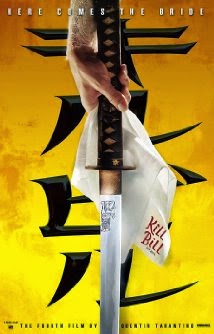


3. Kill Bill Vol. 2


                2. Pulp Fiction


                                                                                                                               1. Reservoir Dogs


It surprised me that "Reservoir Dogs" would make the number one spot on this list. I had seen that film about eight months ago. I remember thinking it was a good movie, but it did not seem extraordinary to me. However, watching it the second time, I realized that it is a near-perfect film. The characters are interesting, the story reveals just enough at a time to constantly keep the audience involved and the pacing is perfect. "Pulp Fiction" had been my favorite for a while -- I still love it -- but it has its slow moments whereas "Reservoir Dogs" does not.

Quentin Tarantino Month was a much more difficult task than I thought it would be, but it was also rewarding.  Writing reviews about movies by the same director is a challenge because what is great about one film is often great about the others. This makes it tedious to discuss every film individually. It was rewarding because watching films by one of the greatest writer/directors of today is a learning experience. I learned a lot about how to use dialogue to create interesting characters and an enjoyable cinematic experience.

Quentin Tarantino Month:

Introduction
Kill Bill: Vol. 1
Kill Bill Vol. 2
Pulp Fiction
Django Unchained
Inglourious Basterds
Jackie Brown
Reservoir Dogs

Like my Facebook page: www.facebook.com/criticalchristopher

Follow me on Twitter: @ChrisCampbell02

Jul 30, 2014

Quentin Tarantino Month: "Jackie Brown"

Jackie Brown

4.5 out of 5 stars

Family appropriateness rating: 2.25 out of 5 stars
Rated R
-Strong language, including f-words, throughout.
-Gun violence. The wounds are never seen on-screen, but blood splatters on a window in one scene.
-One sex scene. It is a brief depiction of anal sex between a heterosexual couple. It is shown from above the waste, and their clothes are on. However, afterwards, the girl walks away, and the top part of her buttocks are clearly shown.


"Jackie Brown" is difficult to understand at first, but it features the best female character Quentin Tarantino has written.

Jackie Brown (Pam Grier) is a middle-aged, single woman working a dead-end job as a flight attendant. An illegal gun salesman named Ordell Robbie (Samuel L. Jackson) uses her to smuggle money from Mexico to California. Coming off a flight, she is stopped by two cops, Ray Nicolette (Michael Keaton) and Mark Dargus (Michael Bowen). They suspect she is somehow connected to Robbie, and upon searching her bag, they find the $50,000 she is smuggling as well as a small bag of cocaine she did not know about.

She gets put in jail, and Robbie pays her bail. He knows she will be offered a plea deal, which will lead to his eventual arrest. His intention in getting her out of jail is so he can kill her before she says anything incriminating. When he goes to her house, she is prepared with a gun, so he cannot go through with the murder.

Robbie is worried about being caught, and there is still $500,000 more that Brown is supposed to smuggle out of Mexico. He wants that money, but he realizes this will be hard to get because Brown is being watched by the police. Because of this, Brown comes up with a slightly convoluted plan to thwart the police and get Robbie his money. Little does he know, Brown is using him for her own purposes.

The plan Jackie Brown lays out is complicated. What she does is different than what she says she will do. In order to fully comprehend it, I needed to watch it a second time. I am glad I did because I have a greater admiration for Jackie Brown and a better appreciation of the movie.

Brown is the best female character Tarantino has ever written. To say she is a smart, independent woman is an understatement. Certain context clues suggest she has been taken advantage of a lot. Now, she knows when people are trying to use her, and she knows how to stand up for herself. She is at a low point in her life, making very little money, and the plan she has will give her a new, fresh start.

Though the story is complicated, especially at first viewing, it is still enjoyable to watch because each supporting character is entertaining. Ordell Robbie is a despicable man. He only looks out for his own interests, and he is willing to kill people to get what he wants.

Robert De Niro plays another despicable character named Louis Gara. He just got out of jail after having served four years for bank robbery, and he now works for Robbie. Even though they are both awful people, Robbie and Gara are completely different. Robbie is a loud, charismatic salesman. Gara is shy and goes along with whatever he is told to do.

De Niro does a great job at bringing his character to life. He has certain mannerisms that show how introverted Gara is. It is one of those performances that is so good, the actor is almost unrecognizable.

Jackie Brown has a love interest in Max Cherry (Robert Forster), a bail bondsman who is getting tired of his lifestyle. Robbie already has the money for bail, but because he does not want to attract any suspicion, he hires Cherry to get Brown out of jail. Cherry immediately finds her attractive, and he does what he can to help her. Both characters are at a point in their lives where they realize they are getting old, and they both have their share of regrets.

The love story is not the main focus, but it does drive the plot forward. Cherry plays a big role in Brown's plan. The fact that he likes her as more than friends is his motivation for helping her. There is some buildup with the love story that pays off in the end without being sappy.

Like my page on Facebook: www.facebook.com/criticalchristopher

Follow me on Twitter: @ChrisCampbell02

Quentin Tarantino Month:

Introduction
Kill Bill: Vol. 1
Kill Bill: Vol. 2
Pulp Fiction
Django Unchained
Inglorious Basterds
Reservoir Dogs

Jul 24, 2014

Quentin Tarantino Month: "Django Unchained"

Django Unchained

4.5 out of 5 stars


Family appropriateness rating: 2.3 out of 5 stars
Rated R
-Graphic bloody violence, often unrealistic, but not as comedic as the "Kill Bill" films.
-Quite a few uses of the n-word, and a moderate amount of other strong profanity including the f-word.
-Brief female nudity. It is only shown for a second and is not intended to be pornographic in any way.


Most films about slavery deal with how helpless black people were during that era. While there is a sense of this in "Django Unchained," the film flips the issue on its head by introducing a slave hero who successfully fights back.

Former dentist, Dr. King Schultz (Christoph Waltz), is an officer of the law who kills wanted men and takes the bounty placed on them. He is searching for three brothers who used to be slave drivers in the Carrucan plantation. With no idea what they look like, he buys a slave who knew them named Django (Jamie Foxx).

Schultz is German and very different from most Americans living in the Southern United States in 1858. He is a progressive who believes slavery is wrong and that Django is a human being. The two make a deal that if Django helps Schultz find the former slave drivers, the doctor will set the slave free.

Django agrees to this, and they form a friendship. Schultz finds out Django has a wife named Broomhilda (Kerry Washington), who is enslaved somewhere in Mississippi. They have been separated for years, and Django misses her. After finding the men Schultz was looking for, the doctor promises to help Django find his wife if he helps catch more bounty for the winter, to which Django agrees.

Upon arriving in Mississippi, they find out that Broomhilda is in an enormous plantation run by the charming, yet downright racist Calvin Candie (Leonardo DiCaprio). The two come up with scheme to get into the plantation and free Broomhilda so her and Django can live happily ever after.

One of the criticisms I have heard about this film is the story is very simple. It is straightforward. There are some twists, but how it all ends is predictable. This is all true, but everything is done well in the hands of a writer/director who knows what he is doing.

Even though it is a very simple concept, Tarantino knows how to write strong characters. They are all distinct individuals who are interesting to watch. The Django character has an arc that is pulled off very well by Jamie Foxx. In the beginning, he is a submissive slave. He has lived in the world for a long time and knows the consequences of insubordination. Even though Schultz is nice to him in the beginning, he still seems suspicious that the doctor will treat him like every other white person does. As the film progresses, he gets more and more used to the freedom he is given. He speaks up for himself and demands respect. This comes off as unexpected and surprising to a lot of white people he comes in contact with.

There is a strong antagonist in this film. To white Southerners living during that time, Calvin Candie is a very charming person. He is hospitable especially to people who can further his interests. He seems to think of himself as a good guy who deserves all the success he gets. However, his attitude towards black people is that they are a completely different species. In his opinion, they deserve to be forced into submission by white people. In an interview on "Meet the Press," Leonardo DiCaprio said that the reason Candie has this ideology is a way to justify in his mind that what he is doing is okay.

As in a lot of other Tarantino films, Samuel L. Jackson plays an important role. He plays an older house slave working for Candie named Stephen. Whenever his master is away, it is Stephen's responsibility to oversee the plantation and make sure it is running. He is feared by all the other slaves, and it appears that he has forgotten that he himself is black. In a way, he is just as racist as his master.

This is not Tarantino's best film, but it is still a very good movie. For the most part, it maintains the same quality of writing and creativity that one can expect from the director. He still uses interesting dialogue to establish his characters, but there is not as much of it and it is not as thought provoking as "Pulp Fiction" or "Kill Bill: Vol. 2."

Like his other films, there are also very interesting camera shots. A couple of them involve someone being killed while riding a horse. Rather than simply showing some blood come out of a man getting shot, Tarantino finds another creative means of presenting it.

The main aspect that should have been better is the Broomhilda character. Tarantino is good at writing strong, female characters, but he misses the mark with this one. She is simply there to be saved and is not given very much characterization aside from being a slave. It would have been nice to see her fleshed out a little more.

Though it is not his best film, it is among his most important. It follows the classic fairy tale formula in which a hero saves a damsel in distress. There is a twist to it in that the hero is a black man living in the pre-Civil War South. He fights against the tyranny of those who oppress others to save the woman he loves. It is empowering to watch considering the fact that even in modern-day cinema, slaves are powerless.

Like my Facebook page: www.facebook.com/criticalchristopher

Follow me on Twitter: @ChrisCampbell02

Quentin Tarantino Month:

Introduction
Kill Bill: Vol. 1
Kill Bill: Vol. 2
Pulp Fiction
Inglourious Basterds
Jackie Brown
Reservoir Dogs

Jul 20, 2014

Quentin Tarantino Month: "Pulp Fiction"

Pulp Fiction

5 out of 5 stars

Family appropriateness rating: 2 out of 5 stars
Rated R
-Some mildly descriptive sexual content (mentions of oral sex).
-One disturbing depiction of male-on-male rape. It is shot from the back, and the men are wearing their clothes. However, it is still graphic in that the action itself is shown.
-One scene of sensuality, and a scene in which a man taking a shower barely covers his private parts.
-Strong language throughout including f-words and n-words.
-I rate it up a little bit in this area because it has an uplifting, religious message to it.


Watching "Pulp Fiction" is like listening to a catchy song. It is a pleasurable experience that sticks with you the first time and does not disappoint in subsequent viewings.

It is not a typical film with one central plot. It has three stories told out of order that relate to each other. Each is about someone involved in a gang led by Marsellus Wallace (Ving Rhames).

One story is about two hit men, Jules (Samuel L. Jackson) and Vincent (John Travolta), who have to retrieve a briefcase from an apartment. Another story is about Vincent taking Marsellus's wife, Mia (Uma Thurman), out to dinner at the gang leader's request. The third story is about a boxer named Butch (Bruce Willis) who is told by Marsellus to throw the next fight but decides not to do so.

To someone casually watching, the stories seem completely random. In fact, when I saw it, I was not sure what they have to do with each other. After some thinking, I figured out that the movie has one central theme of redemption, which can only be understood after watching the movie in its entirety. In each story, something goes wrong, and the characters have to deal with it. Each person has a different motivation for wanting to do the right thing. Only one has selfish motivations behind his actions, and his fate is different than the other two. More about this is explained in the spoiler section of this review.

I have heard people say they get bored watching this movie. I assume this is because most of the film is dialogue. There is some action, but it is mostly people talking. It is not the type of movie to watch with chatty friends who make it hard to focus. In order to get the full experience, one needs to listen to every word the characters say.

Like in his other films, Tarantino uses dialogue to establish characters and detail situations. Although a lot is exposition, it never feels forced because it is in the form of banter between two people. An example of this is in the beginning. Vincent and Jules are introduced as regular guys going to work. They do not talk about what they are going to do so much as they are talk gossip about what happened to a certain gang member for overstepping some boundaries with Marsellus's wife.

Not only does this detail why Vincent is nervous about taking Mia out to dinner, it establishes the culture of the gang as something relatable. It is not just gangsters who gossip, it is any group of people. It reminds me of when I served a Mormon mission. I had a lot of conversations about issues going on with other missionaries.

My favorite story is the one in which Vincent takes Mia out. I consider myself a movie fan, but there are often a lot of aspects about I overlook. One such thing is set designs, but there is one set in this movie that I am impressed with. It is the restaurant where the two characters eat. It is a beautifully-crafted set, and Tarantino takes time to show everything in it using one long take of the camera following Vincent.

It does not hurt that Uma Thurman's Mia character is in that scene as well. A combination of the way her character acts and the way she looks makes her attractive. She is an outgoing woman with a fascination for understanding the world around her. There is an extra layer on her that is never really explained. She never says she is dissatisfied with her marriage or her husband's decisions, but her excessive drug use paired with her flirtatious attitude with Vincent suggest that she might be a little sad about the way her life has been going. Part of what makes her character great is the fact that it is never explained. It is one of those things the artist puts out there to let audience members interpret themselves.

There is one scene in the Vincent story that is both intense and hilarious. It is set within a drug dealer's house as characters are frantically trying to take care of a situation. Tarantino adds to the intensity by taking one long take in which the camera is constantly moving to every character when he or she speaks.

Every performance is phenomenal. In the Blu-ray special features, John Travolta expresses gratitude to Quentin Tarantino for casting him in such a great role. It was filmed in the early '90s when Travolta's career was not very good. The movies he was being cast were dumb "Look Who's Talking" films, and since "Pulp Fiction," he started to get taken more seriously.  Judging from his performance as Vincent, he deserves to be successful. He does a great job as a hit man who is just trying to do his job without any trouble.

Samuel L. Jackson is another actor who needs to be recognized for this movie. He brings a lot of personality to his character, especially when he confronts the men in the apartment. Jules is intimidating to them, but to the audience, it is obvious he is playing. Jules undergoes a rapid change that transpires after a certain event. Jackson does a great job showing this change in a way that does not seem forced.

It helps to watch "Pulp Fiction" multiple times. The stories are out of chronological order, and part of what makes it fun is realizing how consistent every little detail is. For example, there is a part in which Jules and Vincent go into a bar wearing gym shorts and t-shirts as opposed to their classy tuxedos in previous scenes. There is a reason for this, but it is never shown until later in the film.

The message of redemption (spoilers)

When I first saw this movie, I liked it. It is an example of how entertaining a film can be without blowing a huge budget on expensive action scenes. However, I knew there is a lot that I did not completely understand. The main question I had was "Why are these particular stories in the movie?" As stated earlier, this question is something I thought about the next day, and I came up with a tentative answer that it is about redemption. This section goes more in depth with this. It may not be what Tarantino meant, but it is my interpretation of it as an audience member.

When Vincent and Jules are in the apartment, they shoot everyone in the room except for one man named Marvin (Phil Lamarr). Meanwhile, there is another person in a different room listening to the whole incident. Enraged, he jumps out and fires six shots in close range at the hit men. All six miss and hit the wall behind them.

Jules is amazed. Not one bullet hits them. He sees this as an act of God, a miracle. Vincent, however, does not believe it. He thinks it is a strange coincidence but not divine intervention. Jules tells him he cannot be so picky about miracles. What God chooses to show is not always some big flashy sign.

In the end, Jules decides to give up his life of crime. He shows he is a changed man when he helps two bandits realize they should change their lives too.

Vincent should have changed because of the miracle at the apartment, but he stays the same. He is a heroin junkie, who only cares about himself. He finds Mia attractive, and he is afraid of succumbing to his sexual desires. This is not because he feels adultery is morally wrong but because he is afraid of what Marsellus would do if he found out. She ends up overdosing on Vincent's heroine, thinking it is cocaine. This worries him, but it is more out of worry for his own life than out of general concern for her. His reward for being self-absorbed and not changing his ways is he gets shot by Butch.

Butch's story is seemingly the most disconnected from the rest of the film, but even it is about being the better person. Not only does Butch win the fight, he accidentally kills his opponent. Marsellus is angry, and Butch knows it. In fact, he has an escape plan. He and his girlfriend are hiding in a motel, and they are to run away in the morning. Things get complicated when the fighter realizes his gold watch -- which has been in his family for generations -- is still in his apartment. Knowing there are more than likely gang members there, he goes back to retrieve the valuable item.

This leads him to find Marsellus on the street. They get into a fight, and Butch almost kills the gang leader before being stopped by a perverted pawn shop owner named Maynard (Duane Whitaker) who captures them. They end up in his basement where they are to be taken advantage of sexually by the captor and a cop named Zed (Peter Greene).

Marsellus goes first, and Butch manages to escape. He is just about to leave the shop when he realizes that there are some horrific things happening to a human being downstairs. Even though he has had some disagreements with that particular person, he goes back and saves the man. Because of this, the gang leader promises Butch that he will not send anyone to look for the fighter under the condition that he leave the city that day and never return. Had Butch not helped Marsellus, the gang leader's men would have eventually tracked and killed him. In the end, the fighter's good deed is rewarded.

Like my Facebook page: www.facebook.com/criticalchristopher

Follow me on Twitter: @ChrisCampbell02

Quentin Tarantino Month:

Introduction
Kill Bill: Vol. 1
Kill Bill: Vol. 2
Django Unchained
Inglourious Basterds
Jackie Brown
Reservoir Dogs