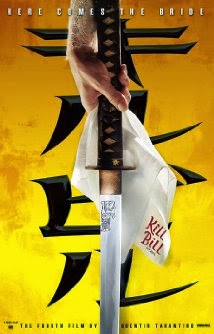
When I started reading film reviews as a teenager, I learned that character development is very important. At first, I was not sure what it meant, but over the years I have come to understand it more and more. It is when the characters are given believable motivation and personality so the audience can connect with them. There was a time when I thought in order for this to happen, their backstories needed to be known. The main thing I learned from watching Quentin Tarantino movies last month is how untrue that is. We do not need to know every detail about the characters' lives.
As has been stated several times in other reviews, Tarantino develops his characters through a steady flow of dialogue. He often sets his scenes up as if it were in a play. There is a setting and there are characters talking in it. They have their own distinct personalities that are revealed through what is being said and the way the actors say it.
A great example of this is Hans Landa (Christoph Waltz) from "Inglourious Basterds." As stated in the review for it, Quentin Tarantino has said in several interviews that Landa is the greatest character he had written. I was not entirely sure why at first because there is very little that is explicitly known about him. He is not given a backstory about why he became a Nazi soldier in the first place. Everything we know about him is revealed through each scene he is in, the most notable being the opening of the film. What is interesting about him, is even though the audience is not given specific details at first, his motivation is shown near the end.
Tarantino has a way of giving just enough information for us to understand the characters and their motivations. However, what is interesting is he often does not reveal everything. For example, in "Pulp Fiction," Vincent (John Travolta) and Jules (Samuel L. Jackson) retrieve a suitcase. It is opened twice in the film, and both times the only thing the movie shows is golden light shining from the inside. The audience never knows what is inside, but it is probably very valuable.
In an interview with Charlie Rose about "Inglourious Basterds," Tarantino said he leaves certain things open for the audience's interpretation. The example from the film he was promoting was Aldo Raine's (Brad Pitt) rope burn on his neck. It is clear to see, but there is no explanation for it. Tarantino said he does this because he wants the experience to be different for everybody. The reason he imagines the rope burn came to be may be different than what I, or any other audience member, may create in our own minds, and it is therefore, a completely different movie to everyone.
There is a big detail about Tarantino films that I left out of my reviews: each pays homage to a specific genre. "Reservoir Dogs" and "Pulp Fiction" were his version of the crime genre, "Jackie Brown" is his black exploitation film, "Kill Bill" is martial arts, "Inglourious Basterds" is a war movie and "Django Unchained" is a spaghetti western. In Hollywood, Tarantino is known for being very knowledgable about cinematic history. He has seen a lot of older films, and some of the genres he tackles are not common today. Most of what I personally know about movies comes from the last 20 to 30 years, and I did not think I could do justice to a discussion on this aspect.
None of the Tarantino movies I have seen are bad by any means, but some are better than others. Here is my list from "worst" to best:
7. Django Unchained
6. Jackie Brown
5. Inglourious Basterds
4. Kill Bill: Vol. 1
3. Kill Bill Vol. 2
2. Pulp Fiction
1. Reservoir Dogs
It surprised me that "Reservoir Dogs" would make the number one spot on this list. I had seen that film about eight months ago. I remember thinking it was a good movie, but it did not seem extraordinary to me. However, watching it the second time, I realized that it is a near-perfect film. The characters are interesting, the story reveals just enough at a time to constantly keep the audience involved and the pacing is perfect. "Pulp Fiction" had been my favorite for a while -- I still love it -- but it has its slow moments whereas "Reservoir Dogs" does not.
Quentin Tarantino Month was a much more difficult task than I thought it would be, but it was also rewarding. Writing reviews about movies by the same director is a challenge because what is great about one film is often great about the others. This makes it tedious to discuss every film individually. It was rewarding because watching films by one of the greatest writer/directors of today is a learning experience. I learned a lot about how to use dialogue to create interesting characters and an enjoyable cinematic experience.
Quentin Tarantino Month:
Introduction
Kill Bill: Vol. 1
Kill Bill Vol. 2
Pulp Fiction
Django Unchained
Inglourious Basterds
Jackie Brown
Reservoir Dogs
Like my Facebook page: www.facebook.com/criticalchristopher
Follow me on Twitter: @ChrisCampbell02
Showing posts with label Movies. Show all posts
Aug 5, 2014
May 7, 2014
The Top 5 Things a Movie/TV Show Needs to be Great
There are times when a string of mediocre or bad movies come out that I ask myself "Why do I subject myself to this kind of torture?"
But they should not be so over-the-top that it is hard to watch without laughing.
They need to reflect real people who have real emotions. An example of a show with great acting is "Breaking Bad." Bryan Cranston has won several Emmys for his performance as a high school chemistry teacher who uses his expertise in science to make methamphetamine to support his family. In the beginning, he is a normal family man, who has a ton of moral hang-ups. By the end he is a hardened criminal, who does not mind killing to get what he wants. Cranston does such a great job executing this through every phase of the character's downfall that it is hard to notice just how much the character has changed by the end.
A great, memorable scene from the show is when he talks to his wife, Skyler (Anna Gunn), about how dangerous a man he has become. Both actors do an excellent job. Cranston is angry and intimidating while Gunn is legitimately scared for her family's safety.
"Breaking Bad" was created by Vince Gilligan and is owned by AMC Networks
4. Well-developed characters
If you read or watch reviews, chances are the term "character development" has come come up, but what exactly does this term mean?
According to the Collins English Dictionary online, it is "The portrayal of people in a work of fiction in such a way that the reader/audience seems to learn more about them and watch them develop."
3. Quality writing and dialogue
Writers who do this right will not only create unique situations and concepts through the storyline, they establish interesting characters through the dialogue.
An example of this is "Her." It is set during a futuristic time in which a new operating system is invented that has artificial intelligence. Joaquin Phoenix plays Theodore, a lonely man going through a divorce, who needs some company. He buys the new operating system and becomes friends with the AI, which he names Samantha (voiced by Scarlett Johansson). Their friendship eventually leads to an intimate relationship.
It sounds like a weird concept, but it is a great movie because of the writing. It gives both Theodore and Samantha distinct personalities through their dialogue. Theodore is likable, and we want to see him happy. Samantha is witty and funny, and it is easy to see why Theodore would fall in love with "her."
The film takes events that would seem very weird if they happened in real life and makes them believable to the audience. They all lead to a theme about how to approach relationships that is very insightful.
At times, the regular plot structure the audience is accustomed to is flipped on its head, which is the case with "Pulp Fiction." This film does not have a normal beginning, middle and end. It is comprised of three stories that connect but are not in chronological order.
Furthermore, the dialogue is not always used to further the story but to establish character. Some of it is thought provoking and some is just there for the audience to further understand who the people are.
One thought provoking piece of dialogue is between the two characters, Vincent (John Travolta) and Mia (Uma Thurman). They are simply eating a meal in a restaurant when Mia says something very interesting:
NOTE: This film is Rated R. I edited out the F-word for anyone reading this who might
find it objectionable. However, there is another four letter word, which is the synonym of
"feces" that I did not take out.
It is when I see a truly great movie that this question is answered. There are films out there that blow my mind. They not only tell a story, they make me feel what the characters are feeling. They are not necessarily realistic in any way, but they seem real to me, the humble audience member sitting in a dark room.
There is a quote I read in several places on the Internet that is commonly attributed to Roger Ebert. I do not know whether or not he actually said it because I have only found it on social media posts. Despite this, it is still a good quote:
"It is said that the human brain divides its functions. The right brain is devoted to sensory impressions, emotions, colors, music. The left brain deals with abstract thought, logic, philosophy, analysis.
"My definition of a great movie: While you're watching it, it engages your right brain. When it's over, it engages your left brain."
In other words, it should appeal to the senses AND it should make you think even after it is done. While there is no definite formula on how to do this, there are five things I have noticed both great movies and great television shows have.
5. Believable performances
Viewing a movie should be an emotional experience. In order to be effective, we as audience members need to relate to the characters. Therefore, the actors should do their part to be as realistic as they can in showing how they would react to the given circumstances.
There needs to be a balance. They should express more emotion than just "Wo" when seeing a man leap from one building to the next.
![]() |
| In "47 Ronin" Rinko Kikuchi tries so hard to be villainous that her performance is laughable. |
But they should not be so over-the-top that it is hard to watch without laughing.
They need to reflect real people who have real emotions. An example of a show with great acting is "Breaking Bad." Bryan Cranston has won several Emmys for his performance as a high school chemistry teacher who uses his expertise in science to make methamphetamine to support his family. In the beginning, he is a normal family man, who has a ton of moral hang-ups. By the end he is a hardened criminal, who does not mind killing to get what he wants. Cranston does such a great job executing this through every phase of the character's downfall that it is hard to notice just how much the character has changed by the end.
A great, memorable scene from the show is when he talks to his wife, Skyler (Anna Gunn), about how dangerous a man he has become. Both actors do an excellent job. Cranston is angry and intimidating while Gunn is legitimately scared for her family's safety.
"Breaking Bad" was created by Vince Gilligan and is owned by AMC Networks
4. Well-developed characters
If you read or watch reviews, chances are the term "character development" has come come up, but what exactly does this term mean?
According to the Collins English Dictionary online, it is "The portrayal of people in a work of fiction in such a way that the reader/audience seems to learn more about them and watch them develop."
Whenever storm troopers in the Star Wars movies get shot, do you really care about them? Of course not. That is because they are not developed at all. To the audience, they are just there to be shot. There is no insight into who they are, where they're from or how their relationships are.
However, the scene in which Darth Vader reveals that he is Luke's father is one of the most iconic in film history because the audience knows these characters. Vader was developed as the ultimate bad guy and Luke as the lovable hero who had been told his father was dead. This revelation would be tough to take in.
3. Quality writing and dialogue
Writers who do this right will not only create unique situations and concepts through the storyline, they establish interesting characters through the dialogue.
An example of this is "Her." It is set during a futuristic time in which a new operating system is invented that has artificial intelligence. Joaquin Phoenix plays Theodore, a lonely man going through a divorce, who needs some company. He buys the new operating system and becomes friends with the AI, which he names Samantha (voiced by Scarlett Johansson). Their friendship eventually leads to an intimate relationship.
It sounds like a weird concept, but it is a great movie because of the writing. It gives both Theodore and Samantha distinct personalities through their dialogue. Theodore is likable, and we want to see him happy. Samantha is witty and funny, and it is easy to see why Theodore would fall in love with "her."
The film takes events that would seem very weird if they happened in real life and makes them believable to the audience. They all lead to a theme about how to approach relationships that is very insightful.
At times, the regular plot structure the audience is accustomed to is flipped on its head, which is the case with "Pulp Fiction." This film does not have a normal beginning, middle and end. It is comprised of three stories that connect but are not in chronological order.
Furthermore, the dialogue is not always used to further the story but to establish character. Some of it is thought provoking and some is just there for the audience to further understand who the people are.
One thought provoking piece of dialogue is between the two characters, Vincent (John Travolta) and Mia (Uma Thurman). They are simply eating a meal in a restaurant when Mia says something very interesting:
NOTE: This film is Rated R. I edited out the F-word for anyone reading this who might
find it objectionable. However, there is another four letter word, which is the synonym of
"feces" that I did not take out.
2. Excellent direction
A movie can have great writing, excellent characters and superb performances but still fail if it has sloppy directing. The director is who determines the look of the film, how it will be put together and the performances.
A director can be responsible for making great actors, like Natalie Portman, deliver monotoned or cheesy performances.

But he or she can also be responsible for making mediocre actors, like John Travolta, deliver a performance worthy of an Oscar nomination.
1. Attention to detail
Since movies and television shows are fictional, filmmakers have to lie to the audience. In real life, the most believable lies that have been told to me are as detailed as possible. This means going beyond the story. Don't just show a beginning, middle and end to a plot. Show a world that is made believable by the little details in it.
"Her" is an excellent example of this. Not only are the characters given depth, the world in which it is set is as well. For example, Theodore works as a writer of personalized letters for people who hire him to do so. This is a very small part of the story, but it is a detail that suggests how impersonal the world has become.
One of my favorite animated shows is "Avatar: The Last Airbender" because of all the details behind it as well as the character development. The world it is set in is so different from our own that talking about the storyline involves explaining the details
It involves four nations, each with people who have the ability to manipulate a specific element: air, water, earth and fire. Only one living person has the ability to manipulate all four, and he or she is known as the Avatar. When that person dies, another one is born.
The story is about an Avatar named Aang, who is only ten years old. When he is burdened with overwhelming responsibilities, he runs away and is frozen underwater for 100 years. During that time, the fire nation takes over the world. When Aang wakes up, he sees what has been done, and he goes on an adventure to restore the nations with two people from the south pole: Katara — who has the ability to manipulate water — and her brother Sokka.
Throughout the series, there are a lot of details that make this world unique. For example, the nations are all different in size and culture, the earth kingdom being the largest, and the air nomads technically being the smallest because Aang is the only one living by the time the show starts. There are also different animals within this world, which are normally combinations of real ones like the platypus-bear. It gets detailed even down to myths behind the show. One episode discusses one such myth that explains how the city of Omashu got its name.
"Breaking Bad" is another example of a world full of little details. The concept behind it is not so far fetched that it cannot be done, but there are fictional businesses like one described in the first season called Tampico Furniture. This business is mentioned as Walter White is deciding whether or not to kill a man named Krazy-8 (Max Arciniega), who Walter finds out comes from the family that owns the store. In the conversation, it is revealed that Walter had bought his son's crib there years before the show starts.
Not only does this add depth to the world of "Breaking Bad," it adds character to Krazy-8. He is not just some guy involved in the drug business, he has a mother and father, he had a childhood, he is a person. This information helps the audience feel the gravity of the situation Walter is in.
Like my Facebook page www.facebook.com/criticalchristopher
Follow me on Twitter@ChrisCampbell02
A movie can have great writing, excellent characters and superb performances but still fail if it has sloppy directing. The director is who determines the look of the film, how it will be put together and the performances.
A director can be responsible for making great actors, like Natalie Portman, deliver monotoned or cheesy performances.

But he or she can also be responsible for making mediocre actors, like John Travolta, deliver a performance worthy of an Oscar nomination.
1. Attention to detail
Since movies and television shows are fictional, filmmakers have to lie to the audience. In real life, the most believable lies that have been told to me are as detailed as possible. This means going beyond the story. Don't just show a beginning, middle and end to a plot. Show a world that is made believable by the little details in it.
"Her" is an excellent example of this. Not only are the characters given depth, the world in which it is set is as well. For example, Theodore works as a writer of personalized letters for people who hire him to do so. This is a very small part of the story, but it is a detail that suggests how impersonal the world has become.
One of my favorite animated shows is "Avatar: The Last Airbender" because of all the details behind it as well as the character development. The world it is set in is so different from our own that talking about the storyline involves explaining the details
It involves four nations, each with people who have the ability to manipulate a specific element: air, water, earth and fire. Only one living person has the ability to manipulate all four, and he or she is known as the Avatar. When that person dies, another one is born.
The story is about an Avatar named Aang, who is only ten years old. When he is burdened with overwhelming responsibilities, he runs away and is frozen underwater for 100 years. During that time, the fire nation takes over the world. When Aang wakes up, he sees what has been done, and he goes on an adventure to restore the nations with two people from the south pole: Katara — who has the ability to manipulate water — and her brother Sokka.
Throughout the series, there are a lot of details that make this world unique. For example, the nations are all different in size and culture, the earth kingdom being the largest, and the air nomads technically being the smallest because Aang is the only one living by the time the show starts. There are also different animals within this world, which are normally combinations of real ones like the platypus-bear. It gets detailed even down to myths behind the show. One episode discusses one such myth that explains how the city of Omashu got its name.
"Breaking Bad" is another example of a world full of little details. The concept behind it is not so far fetched that it cannot be done, but there are fictional businesses like one described in the first season called Tampico Furniture. This business is mentioned as Walter White is deciding whether or not to kill a man named Krazy-8 (Max Arciniega), who Walter finds out comes from the family that owns the store. In the conversation, it is revealed that Walter had bought his son's crib there years before the show starts.
Not only does this add depth to the world of "Breaking Bad," it adds character to Krazy-8. He is not just some guy involved in the drug business, he has a mother and father, he had a childhood, he is a person. This information helps the audience feel the gravity of the situation Walter is in.
Like my Facebook page www.facebook.com/criticalchristopher
Follow me on Twitter
Subscribe to:
Posts (Atom)