Showing posts with label crime. Show all posts

Aug 5, 2014

Quentin Tarantino Month: Conclusion

When I started reading film reviews as a teenager, I learned that character development is very important. At first, I was not sure what it meant, but over the years I have come to understand it more and more. It is when the characters are given believable motivation and personality so the audience can connect with them. There was a time when I thought in order for this to happen, their backstories needed to be known. The main thing I learned from watching Quentin Tarantino movies last month is how untrue that is. We do not need to know every detail about the characters' lives.

As has been stated several times in other reviews, Tarantino develops his characters through a steady flow of dialogue. He often sets his scenes up as if it were in a play. There is a setting and there are characters talking in it. They have their own distinct personalities that are revealed through what is being said and the way the actors say it.

A great example of this is Hans Landa (Christoph Waltz) from "Inglourious Basterds." As stated in the review for it, Quentin Tarantino has said in several interviews that Landa is the greatest character he had written. I was not entirely sure why at first because there is very little that is explicitly known about him. He is not given a backstory about why he became a Nazi soldier in the first place. Everything we know about him is revealed through each scene he is in, the most notable being the opening of the film. What is interesting about him, is even though the audience is not given specific details at first, his motivation is shown near the end.

Tarantino has a way of giving just enough information for us to understand the characters and their motivations. However, what is interesting is he often does not reveal everything. For example, in "Pulp Fiction," Vincent (John Travolta) and Jules (Samuel L. Jackson) retrieve a suitcase. It is opened twice in the film, and both times the only thing the movie shows is golden light shining from the inside. The audience never knows what is inside, but it is probably very valuable.

In an interview with Charlie Rose about "Inglourious Basterds," Tarantino said he leaves certain things open for the audience's interpretation. The example from the film he was promoting was Aldo Raine's (Brad Pitt) rope burn on his neck. It is clear to see, but there is no explanation for it. Tarantino said he does this because he wants the experience to be different for everybody. The reason he imagines the rope burn came to be may be different than what I, or any other audience member, may create in our own minds, and it is therefore, a completely different movie to everyone.

There is a big detail about Tarantino films that I left out of my reviews: each pays homage to a specific genre. "Reservoir Dogs" and "Pulp Fiction" were his version of the crime genre, "Jackie Brown" is his black exploitation film, "Kill Bill" is martial arts, "Inglourious Basterds" is a war movie and "Django Unchained" is a spaghetti western. In Hollywood, Tarantino is known for being very knowledgable about cinematic history. He has seen a lot of older films, and some of the genres he tackles are not common today. Most of what I personally know about movies comes from the last 20 to 30 years, and I did not think I could do justice to a discussion on this aspect.

None of the Tarantino movies I have seen are bad by any means, but some are better than others. Here is my list from "worst" to best:

7. Django Unchained


              6. Jackie Brown


                                                                                                                          5. Inglourious Basterds


                                                                 4. Kill Bill: Vol. 1
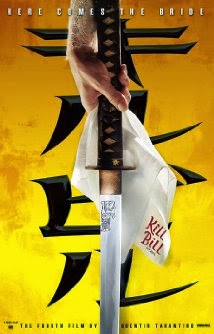


3. Kill Bill Vol. 2


                2. Pulp Fiction


                                                                                                                               1. Reservoir Dogs


It surprised me that "Reservoir Dogs" would make the number one spot on this list. I had seen that film about eight months ago. I remember thinking it was a good movie, but it did not seem extraordinary to me. However, watching it the second time, I realized that it is a near-perfect film. The characters are interesting, the story reveals just enough at a time to constantly keep the audience involved and the pacing is perfect. "Pulp Fiction" had been my favorite for a while -- I still love it -- but it has its slow moments whereas "Reservoir Dogs" does not.

Quentin Tarantino Month was a much more difficult task than I thought it would be, but it was also rewarding.  Writing reviews about movies by the same director is a challenge because what is great about one film is often great about the others. This makes it tedious to discuss every film individually. It was rewarding because watching films by one of the greatest writer/directors of today is a learning experience. I learned a lot about how to use dialogue to create interesting characters and an enjoyable cinematic experience.

Quentin Tarantino Month:

Introduction
Kill Bill: Vol. 1
Kill Bill Vol. 2
Pulp Fiction
Django Unchained
Inglourious Basterds
Jackie Brown
Reservoir Dogs

Like my Facebook page: www.facebook.com/criticalchristopher

Follow me on Twitter: @ChrisCampbell02

Jul 31, 2014

Quentin Tarantino Month: "Reservoir Dogs"

Reservoir Dogs

5 out of 5 stars

Family Appropriateness rating: 2 out of 5 stars
Rated R
-A moderate amount of gun violence, some showing gun wounds as it happens.
-Quite a bit of blood is shown, but it is mostly on someone who had been shot previously. It is enough to form a small puddle by the end.
-Strong language, including f-words in both sexual and non-sexual contexts, throughout.


"Reservoir Dogs" knows it is a simple movie and stays focused on what is important.

Most of the film is set in a warehouse, where several members of a robbery gang are hiding out. One of them, Mr. Orange (Tim Roth), has a bullet wound in his belly. He is suffering a slow, painful death and needs medical attention as soon as possible. However, some of the other gang members do not know what to do. They are afraid that if they take Orange to a hospital, he will give them away when the police ask questions.

They have just returned from a robbery that did not go well at all. As they were stealing diamonds, someone sounded an alarm, one of the members -- Mr. Blonde (Michael Madsen) -- shot a few people, and the cops came. The gangsters are suspicious that someone in the group is a mole because the police came to the scene much more quickly than normal.

This film is the simplest of the Tarantino films, but it is definitely one of the best. The premise is not overly complicated, and it never attempts to be more than it needs. The only twist is the revelation of who the mole is. Not straying into complexity allows the movie to focus on the characters. In this aspect, Quentin Tarantino is at the top of his game in this film. There are four major characters, and each is memorable for different things.

Mr. Pink (Steve Buscemi) is established from the beginning as a jerk. Before the opening credits, there is a scene with all the gang members in a restaurant. Though this event has nothing to do with the rest of the film, it gives insight into who Mr. Pink is. When everyone is tipping the waitress, he refuses to do so because he thinks it is ridiculous that society expects him to pay more to someone who is just doing a service. In his opinion, it is unnecessary unless the person went above and beyond. He does not care that some people live off of tips. This scene indicates he is self-absorbed. He rarely does anything for other people, and he constantly justifies himself for being that way. This trait is consistent throughout the film.

Mr. White (Harvey Keitel) is the opposite. He is a calm, older man who wants to see the best in people. When Mr. Pink suspects that someone is a mole, White is infuriated. He does not think anyone in their company would snitch on them. None of the gang members go by their real names so they cannot testify against each other, and White is so trusting that he reveals his first name to another character at one point.

Mr. Blonde is a psychopath. This is both said by other characters and shown in a memorable, yet disturbing scene. While he commits atrocious acts, he has the radio set to up-beat dance music. He proceeds to make some comical motions, which shows how crazy he is.

Every single scene is entertaining. This is due to interesting characters, a focused plot and details that are not revealed all at once. Right after the opening credits, the first thing that is shown is Mr. Orange in the back seat of a car with blood everywhere. How or why this happened is not explained at first, but it is eventually. In the end, all of the questions that have been risen are answered.

Like my Facebook page: www.facebook.com/criticalchristopher

Follow me on Twitter: @ChrisCampbell02

Quentin Tarantino Month

Introduction
Kill Bill: Vol. 1
Kill Bill: Vol. 2
Pulp Fiction
Django Unchained
Inglorious Basterds
Jackie Brown